How to Sell 3D Models Online
You can sell 3D models to game developers, filmmakers, designers and people with 3D printers. Each marketplace pays differently and has its own rules, especially for AI-generated models. This guide puts the numbers and rules side by side, then shows how to make a listing that actually sells.
By the Bake3D teamUpdated 6 min read
Short answer
To sell 3D models online, list them on a marketplace that fits your buyers. Game and design assets sell on CGTrader, Fab and TurboSquid. 3D printing files sell on Printables, Cults3D, Thangs, MakerWorld and Etsy. Sellers keep from about 40% to 88% of each sale, depending on the site. If your models are AI-generated, check the rules first. TurboSquid bans them, and most others require a label.
How we checked this: The payout rates and AI rules come from each marketplace's own help pages, terms and fee pages, read on 25 September 2026 and linked below. A few marketplaces blocked our reader, and we say so where that applies. Rules change often, so check the marketplace before you upload. This guide is not legal advice.
There are two big groups of buyers for 3D models. One group builds games, films, apps and product visuals. They want clean meshes, textures, rigs and animations in formats like FBX and GLB. The other group owns 3D printers. They want STL or 3MF files that print well the first time. Different marketplaces serve each group, so start by deciding who you are selling to.
Where to sell 3D models: the numbers
| Marketplace | Main buyers | What sellers keep | AI-generated models |
|---|---|---|---|
| Fab (Epic Games) | Game and film makers | 88% | Allowed, “Created with AI” flag required |
| CGTrader | Game, film and design | 55% to 80%, based on your last 365 days of sales | Allowed; no ban found in its policies |
| TurboSquid | Film, design, games | 40%, up to 80% with its programs | Not accepted |
| Printables (Prusa) | 3D printing | Store takes a 20% commission | Buyers can filter AI out |
| Cults3D | 3D printing | About 80% | Allowed, hidden from buyers by default |
| Thangs | 3D printing | Fee of 30%, 20% or 15%, lower on pricier models | No special rule; previews must be real print photos where possible |
| MakerWorld (Bambu Lab) | 3D printing | Points, cash rewards for exclusive models, memberships | Must be tagged, and left out of the cash program |
| Etsy | Gift buyers and makers | $0.20 per listing plus a 6.5% fee and payment costs | Allowed, must be disclosed in the listing |
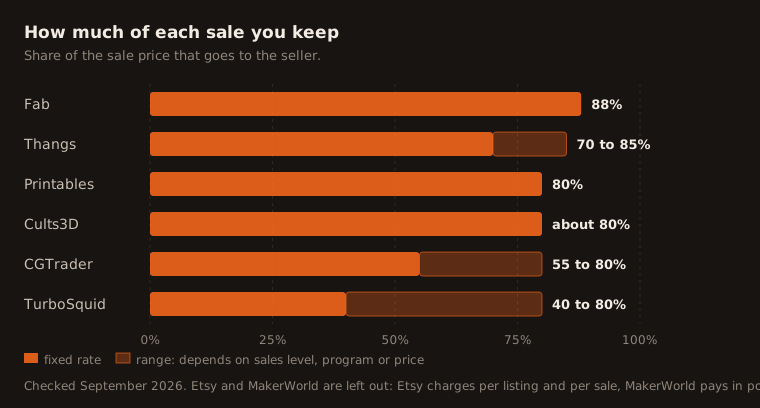
A few notes. CGTrader’s new payout table started on September 15, 2026, with 26 levels from 55% to 80%. We could not load Cults3D’s and Printables’ own pages when we checked, so their numbers come from their search listings and Prusa’s terms. Check them before you upload.
What changed recently
- The Sketchfab store is closed. It stopped selling on October 22, 2024, and sales moved to Fab. You can still share and embed free models on Sketchfab.
- Sketchfab has a new owner. KitBash announced that it bought Sketchfab and ArtStation from Epic in August 2026. Epic kept Fab.
- CGTrader shared a telling number. In July 2026, it said AI-made models were about 1 in 6 uploads, but only about 1 in 90 dollars of sales.
That last point matters. Raw AI output is easy to make, so there is a lot of it. Buyers pay for models that someone has checked, cleaned and finished.
Selling game, film and design assets
Fab has the highest listed share, at 88%. It is Epic’s store, so Unreal Engine users shop there, but it sells assets for any engine.
CGTrader is one of the largest general 3D marketplaces. Your share grows as your yearly sales grow. Since May 15, 2026, standard CGTrader listings are not licensed for AI training.
TurboSquid is owned by Shutterstock. It pays 40% by default, more if you sell only there and use its affiliate program. It does not accept AI-generated content.
What these buyers look for:
- Clean shape, with no holes or stray parts.
- Real-world scale, in metres or centimetres.
- Textures included and linked.
- Common formats: FBX, GLB, OBJ, and often a Blender file.
- A rig and animations, when the model is a character. Rigged, animated characters usually sell for more than static ones.
- An honest polygon count in the description.
Selling 3D printing files
Printables is run by Prusa. Its store takes a 20% commission, and its paid Club takes 10%. You may only sell models you made yourself.
Cults3D pays designers about 80% of the net price.
Thangs takes a smaller cut on more expensive models: 30% under $5, 20% from $5 to under $10, and 15% at $10 or more.
MakerWorld pays creators in other ways than per download. Creators earn points, cash rewards for exclusive models, paid memberships and a share of parts sales. AI-generated models, and models made with its own MakerLab tools, are left out of its cash rewards program.
Etsy works well for gift ideas, like STL files for keychains, planters or cookie cutters. It charges $0.20 per listing and 6.5% per sale, plus payment processing.
What these buyers look for:
- A model that prints without supports, or with few of them.
- A flat base and walls thick enough for a normal printer.
- Photos of a real print, as well as renders. Thangs asks for real print photos where possible.
- Print settings in the description: layer height, supports, infill.
- STL and 3MF files. See 3MF vs STL.
Can you sell AI-generated 3D models?
Often yes, but the rules differ a lot.
| Marketplace | Rule for AI-made models |
|---|---|
| TurboSquid | Not accepted |
| Fab | Allowed; the “Created with AI” flag is required |
| Sketchfab | Must be labeled “CreatedWithAI” |
| Etsy | Allowed; say so in the listing description |
| MakerWorld | Tag as AIGC; not eligible for cash rewards |
| Cults3D | Allowed; hidden by a “No AI” filter that is on by default |
| CGTrader | No ban found in its terms or content policy |
Two more things to know before you sell AI-made work:
- Copyright. In the United States, the Copyright Office says prompts alone do not give enough human control for copyright. Human edits, sculpting, selection and arrangement can be protected. In March 2026, the Supreme Court declined to hear an appeal on this question, so the human-authorship rule stands. This is not legal advice.
- Your tool’s license. Check that the AI tool lets you sell what it makes. Bake3D models made with purchased credits carry a commercial, royalty-free license that stays valid after you stop paying. Models made only with the free sign-up credits are for personal use. See pricing for details.
How to make a 3D model listing that sells
- Finish the model. Fix holes, clean up stray parts and set the scale. For printing, run it through our free STL checker.
- Reduce the weight if needed. Heavy meshes put buyers off. See how to reduce polygon count.
- Add value. A rig and a few animations turn a static character into a ready-to-use asset. See auto rigging.
- Make good preview images. Show the front, side and back, a wireframe, and the model in use. For print files, show a real print.
- Write a clear title. Say what it is, the style and the use, like “Low poly fox, rigged and animated, game ready”.
- List the facts. Formats, polygon count, texture sizes, rig and animation list, and print settings.
- Tag it honestly, including the AI tag if a marketplace asks for one.
- Price it by looking at similar listings on the same site.
- Answer questions quickly. Good reviews help your next sales.
Make a model worth buying
The models that sell are the ones that save a buyer time. A rigged, animated character in both FBX and GLB saves a game developer hours of work. A figurine that prints without supports saves a maker a failed print. Bake3D can take you from one image to a textured, rigged and animated model, with GLB, FBX, STL and OBJ exports. See how on the solution page for 3D model marketplaces.
Questions people ask
Can I sell AI-generated 3D models?
On many marketplaces, yes, with a label. Fab and Sketchfab require an AI tag, Etsy requires a note in the listing, and MakerWorld asks for an AIGC tag. TurboSquid does not accept AI-generated content at all. Human editing and clean files make a big difference in sales.
Which 3D model marketplace pays sellers the most?
Of the sites in this guide, Fab lists the highest share at 88%. CGTrader pays 55% to 80%, depending on your sales over the past year. TurboSquid starts at 40% and can reach 80% through its programs.
Can I sell STL files on Etsy?
Yes. Etsy allows digital downloads. It charges $0.20 per listing and a 6.5% transaction fee, plus payment processing. Items made with AI must say so in the description.
Can I sell models I made with Bake3D?
Yes, if you made them with purchased credits. Those assets carry a commercial, royalty-free license that stays valid after you stop paying. Models made only with the free sign-up credits are for personal use. You still need to follow each marketplace's AI rules.
Are AI-generated 3D models protected by copyright?
In the United States, the Copyright Office says prompts alone do not give enough human control for copyright. Human edits, sculpting and creative choices can be protected. This is not legal advice. Talk to a lawyer about your case.
Sources
- CGTrader, Payout rate system explained
- CGTrader, 3D model market trends 2026
- TurboSquid, Policy on publishing AI-generated content
- TurboSquid, Royalty percentage
- Fab, Become a publisher
- Fab, NoAI meta tags and Created with AI self-declaration
- Sketchfab, Update now that Fab is live
- Printables, Club and Store terms for creators
- Etsy, Fees and payments policy
- Etsy, Creativity standards
- Thangs, Getting started for designers
- MakerWorld, Exclusive model guideline
- US Copyright Office, Copyright and Artificial Intelligence
About this guide
Written and kept up to date by the Bake3D team. We build a tool that turns one image into a textured, rigged and animated 3D model, and we test the steps in our guides on our own files. First published . See how we write and check guides, or send a correction to hello@bake3d.ai.
Keep reading
3D printing
How to Make a Custom 3D Figurine From a Photo
Turn a photo of yourself, a pet or a character into a 3D printed figurine. Compare AI, photo scanning and paid services, then print it well.
3D printing
How to Make an STL File for 3D Printing
Five ways to make an STL file: from a photo, a logo, a quick design, an existing 3D model or an AI tool. Plus how to check it before you print.
Blender
How to Reduce Polygon Count in Blender
Lower the polygon count of a 3D model with the Decimate modifier in Blender. Target counts for games, web and mobile, and what to check after.