Quadruped Walk Cycle: How Four-Legged Animals Walk
A four-legged walk looks simple until you try to animate one. Which foot moves first? How long does each foot stay down? This guide gives you the footfall order, a frame chart you can copy, and tips for dogs, cats, horses, insects and spiders.
By the Bake3D teamUpdated 9 min read
Short answer
In a normal four-legged walk, the feet land one at a time in this order. Left hind, left front, right hind, right front, then repeat. Each foot stays on the ground for about three quarters of the cycle, so three feet hold the body up most of the time. At 24 frames per second with a one-second cycle, a new foot lands every 6 frames.
How we checked this: The footfall order, stance time and timing chart come straight from the walk that Bake3D's engine builds for four-legged rigs, which our automated tests check on several different body shapes. The animal biology is summarized from the published research listed under Sources.
For a long time, nobody could say for sure how a horse’s legs moved. The legs were too fast for the eye. On June 19, 1878, the photographer Eadweard Muybridge lined up a row of cameras along a track in Palo Alto and photographed a horse named Sallie Gardner. His photos settled the question and gave animators a reference they still use today.
You do not need a row of cameras. You need the footfall order, the timing and a few tips about how the body moves. That is what this guide covers.
The footfall order of a four-legged walk
When dogs, cats, horses and most other four-legged animals walk, they move one foot at a time. The order is:
- Left hind
- Left front
- Right hind
- Right front
Then it starts again. An easy way to remember it: back, front, switch sides. Scientists call this a lateral sequence walk, because a hind foot is followed by the front foot on the same side. Biologists have measured this order in horses, dogs, cats, elephants and many other animals.
Each foot spends more time on the ground than in the air. Scientists call this share the duty factor. In any walk it is more than half. Research on medium and large mammals puts it at about 0.6 to 0.75. In Bake3D’s walk, each foot is down for three quarters of the cycle and up for one quarter. So three feet hold the body up at almost every moment. That is why the walk is the gait animals use to move slowly and carefully.
A frame chart you can copy
Here is one full walk cycle, 24 frames long. At 24 frames per second, that is one second.
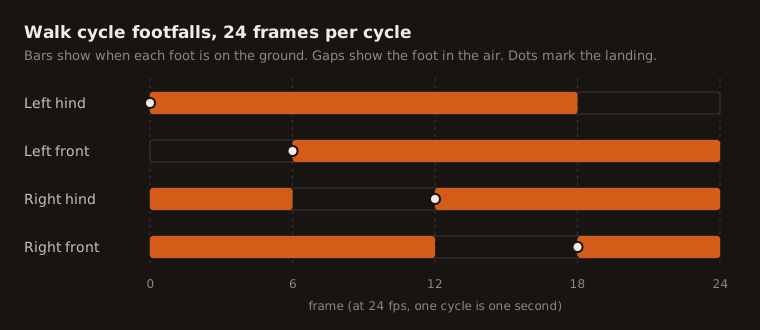
| Frame | Foot that lands | Foot in the air until the next landing |
|---|---|---|
| 0 | Left hind | Left front |
| 6 | Left front | Right hind |
| 12 | Right hind | Right front |
| 18 | Right front | Left hind |
| 24 | Left hind again (same as frame 0) |
Notice the pattern. Each foot lifts 6 frames before it lands, and lands 6 frames after the one before it. Only one foot is ever in the air.
This matches the classic horse walk timing in the animation book Timing for Animation by Harold Whitaker and John Halas. In their 24-frame cycle, the feet land on frames 1, 7, 13 and 19. That is the same spacing, counted from 1 instead of 0.
To animate it, key the contact poses first: the frames where each foot lands. Then add the passing poses in between, where the lifted foot swings past the planted leg on its side.

How long should the cycle be?
There is no single right length. Size and mood change it.
- Start with one cycle per second. That is 24 frames at 24 fps, or 30 frames at 30 fps. Whitaker and Halas give a horse about a second per walking stride, and Bake3D’s walk preset uses this pace too.
- Small animals step faster. The same book says a cat may take a full stride in half a second or less.
- Big animals step slower. It gives an elephant about 1 to 1.5 seconds per stride.
- Mood matters. A tired or sneaking animal walks slower. An excited one walks faster.
The best reference is video of the real animal. Count the frames between two landings of the same foot, and use that as your cycle length.
The body moves too
A walk is not just legs. If only the legs move, the animal looks like a toy on a string. Add these on top:
- Hips and shoulders rise and fall. The body dips a little when a foot lands and lifts as the leg pushes.
- The spine bends side to side. Watch a dog from above. Its back curves gently left and right with each step.
- The head nods. Many animals, horses most of all, nod the head down as a front foot lands.
- The tail follows. A tail should lag behind the body and swing a few frames late. The same goes for ears.
Bake3D’s walk adds spine, head and tail follow-through for you, fitted to your rig’s own proportions.
Dog walk cycle tips
- Dogs walk on their toes. The joint that looks like a backward knee on the hind leg is really the ankle, called the hock. The real knee sits high, close to the body.
- Front legs have a wrist. It folds as the paw lifts, and the paw flicks forward before it lands.
- Keep the back fairly level. A dog’s head stays steady and the body flows forward.
- Big and small dogs differ. A Great Dane moves slowly and heavily. A terrier moves in quick, short steps.
Cat walk cycle tips
- Same order, more grace. Cats use the same left hind, left front, right hind, right front order.
- Step into the front print. A walking cat usually places each hind paw right on top of the print its front paw just left. Trackers call this direct register. It keeps the steps quiet and sure.
- Shoulder blades roll. Each front step makes the shoulder blade rise and fall under the skin.
- Low and smooth. Keep the body close to the ground with very little bounce.
- A loose tail. Let it curve and sway slowly.
Horse walk cycle tips
- Four clear beats. A horse’s walk has four separate hoof beats, evenly spaced.
- Big head nod. The head and neck swing down and up with each front step. This is one of the most visible parts of a horse walk.
- Long leg joints. The hock on the back leg and the fetlock above each hoof bend a lot as the leg lifts.
- Weight. Let the body sink a little onto each landing leg.
Other gaits: trot, pace, canter and gallop
When animals go faster, the footfall pattern changes.
| Gait | How the feet move | Beats | Who uses it |
|---|---|---|---|
| Walk | One foot at a time: LH, LF, RH, RF | 4 | Almost all four-legged animals |
| Trot | Diagonal pairs: left front with right hind | 2 | Dogs, horses, many mammals at medium speed |
| Pace | Same-side pairs: both left legs, then both right | 2 | Camels, bears, some horses and long-legged dogs |
| Canter | Three beats with a lead leg | 3 | Horses |
| Gallop | Hind pair, then front pair, with a moment in the air | 4 | Horses, dogs, cheetahs at top speed |
Giraffes are a fun exception. Their legs on one side move almost together when they walk, so it looks like a pace. But it is still a walk, and giraffes go straight from walking to galloping.
There are two kinds of gallop. In a transverse gallop, used by horses, the feet land in a zigzag across the body. In a rotary gallop, used by cheetahs, the feet land in a circle around the body. Dogs switch from transverse to rotary as they speed up. Bake3D’s gallop is rotary. The hind pair lands, then the front pair, with a strong bend and stretch of the spine and a moment with all four feet off the ground.
The trot is the easiest fast gait to animate, because each diagonal pair acts like one leg. Bake3D’s trot is built the same way, with bounce added to the spine, head and tail.
Six and eight legs
Many creatures have more than four legs. The same rules still apply. Keep the body supported, and never lift two neighbor legs at the same time.
- Insects (six legs) change gait with speed. Slow insects step in a wave, one leg after another, from back to front. Fast insects use a tripod gait. The front and back legs on one side move together with the middle leg on the other side. That leaves a steady triangle of three feet on the ground.
- Spiders (eight legs) move four legs at a time, in two alternating sets. Studies of tarantulas show the sets as left 1, right 2, left 3 and right 4, then right 1, left 2, right 3 and left 4. Legs next to each other, and legs straight across from each other, are always in opposite sets.
Bake3D’s walk for six or more legs uses a wave that runs from the back legs to the front. Neighbor legs on the same side are a third of a cycle apart, and the left and right sides are half a cycle apart. So no two neighbor legs are ever in the air together. The run preset switches to tripods for six or more legs.
Common walk cycle mistakes
- Feet slide on the ground. A planted foot must not move. Use IK on the legs, and match the body’s travel to the stride.
- All four legs move in pairs. That is a trot, not a walk. For a walk, space the four landings evenly.
- Even, robotic timing. Add a little ease as each foot lifts and lands.
- A stiff spine. Let the back bend and the hips tilt.
- Legs bend the wrong way. On the hind legs of dogs, cats and horses, the hock points backward. Check your rig’s joint placement.
- The loop pops. The last frame must match the first. Copy frame 0 to the last frame.
Make a walk cycle in minutes
If your character is already rigged, Bake3D can build the walk for you. Its walk preset finds every leg on the rig, whether there are two, four, six or eight. It then works out the stride from the shortest leg, so the feet reach the ground without stretching. You can export it in place or with root motion, at 24, 30 or 60 frames per second.
Do not have a rigged model yet? Start with how to rig a quadruped from one image, or read what rigging is first. To take your walk into an engine, see how to animate a 3D model for export tips.
Questions people ask
What order do a dog's legs move when it walks?
A walking dog moves one leg at a time. A hind leg steps, then the front leg on the same side, then the other hind leg, then the other front leg. For example, left hind, left front, right hind, right front.
How many frames is a quadruped walk cycle?
A good place to start is 24 frames at 24 frames per second, which is one full cycle per second. Use fewer frames for small, quick animals and more for big, heavy ones. Then check against video of the real animal.
What is the difference between a walk and a trot?
In a walk, the four feet land one at a time. In a trot, the legs move in diagonal pairs. The left front and right hind land together, then the right front and left hind. A trot is faster and bouncier.
Do cats walk differently from dogs?
The footfall order is the same. Cats often place each hind paw close to where the front paw on that side just stepped. They also keep their body low and smooth, with a loose, swaying tail.
How do spiders and insects walk?
Fast insects move three legs at a time, like a tripod. Slow insects step in a wave from back to front. Spiders move four legs at a time, in two alternating sets, so neighbor legs never lift together.
Sources
- Hildebrand, M. (1965). Symmetrical gaits of horses. Science 150, 701 to 708
- Usherwood and Self Davies (2017). Work minimization accounts for footfall phasing in slow quadrupedal gaits. eLife
- Dagg, A. I. (1973). Gaits in mammals. Mammal Review 3, 135 to 154
- Biancardi and Minetti (2012). Biomechanical determinants of transverse and rotary gallop. Journal of Experimental Biology
- Ramdya et al. (2017). Climbing favours the tripod gait over alternative faster insect gaits. Nature Communications
- Wilson, D. M. (1967). Stepping patterns in tarantula spiders. Journal of Experimental Biology
- US National Park Service, Mount Rainier carnivore tracks guide (direct register)
- Muybridge, E. (1878). Sallie Gardner running at the Palo Alto track, Library of Congress
- Whitaker, H. and Halas, J. (1981). Timing for Animation. Focal Press
About this guide
Written and kept up to date by the Bake3D team. We build a tool that turns one image into a textured, rigged and animated 3D model, and we test the steps in our guides on our own files. First published . See how we write and check guides, or send a correction to hello@bake3d.ai.
Keep reading
Animation
How to Animate a 3D Model
Four ways to animate a 3D model: keyframes, motion libraries, motion capture and described motion. What each one needs and when to use it.
Rigging
Rig a quadruped from one image
What Bake3D checks when it rigs a four-legged creature from one picture, how to read the placement and deformation reports, and how to fix common problems.
Rigging basics
What Is Rigging in 3D Animation?
Rigging gives a 3D model a skeleton so it can move. Learn what bones, joints, skin weights and weight painting are, with simple examples.